
Whistleblower Retaliation Claims – Employers Need to be Aware

The Whistleblower Law Employers Fear Most
How California Labor Code § 1102.5 became the go-to retaliation claim — and what the last two years of case law mean for your organization
Since the California Supreme Court’s 2022 Lawson decision, surviving a whistleblower retaliation claim has become significantly harder for employers. Recent decisions have pushed that trend further, but 2025 also brought a few meaningful wins for the defense.
Why § 1102.5 Is Different
California Labor Code § 1102.5 prohibits employers from retaliating against employees who report suspected legal violations, testify before a public body, or refuse to participate in activity that would break the law. On its face, that sounds similar to other anti-retaliation statutes.
What makes § 1102.5 unusually powerful is the combination of who it protects and how claims are evaluated. Protection extends even to employees whose reporting is part of their normal job duties, and even when the employer already knew about the conduct being reported. The statute protects disclosure to a government agency, to anyone with authority over the employee, or to any colleague with authority to investigate, as long as the employee reasonably believes the information shows a legal violation.
The Lawson Framework: Why Summary Judgment Is So Hard
Before 2022, most California retaliation claims (including those under § 1102.5) were evaluated under the McDonnell Douglas burden-shifting test borrowed from federal law. Then the Supreme Court intervened. In Lawson v. PPG Architectural Finishes, Inc. (2022), the court held that Labor Code § 1102.6 (not the McDonnell Douglas standard) provides the framework for these claims. The difference is dramatic:
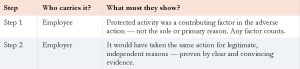
The “contributing factor” standard at Step 1 is far easier for plaintiffs to meet than the “substantial motivating reason” standard under FEHA. And placing a clear-and-convincing burden on the employer at Step 2 is one of the highest civil standards in California law. Combined, these two features have made § 1102.5 the preferred vehicle for retaliation claims.
What the Last Two Years Changed
Case law from 2023 through early 2026 has refined — and in some areas significantly expanded — the scope of the statute. Four decisions stand out.
- A complaint doesn’t have to be news to be protected – Garcia-Brower v. Kolla’s, Inc., (2023) 14 Cal.5th 719. The Supreme Court rejected the old rule that only the first report of a violation is protected. An employee who reports conduct the employer already knows about is still making a protected disclosure. This eliminates a common defense strategy and makes internal complaints much harder to dismiss.
- Elected officials are not “employees” – Brown v. City of Inglewood, (2025) 18 Cal.5th 33. A win for public agencies. The court held that elected officials — even those receiving W-2 compensation — fall outside the statute’s definition of “employee.” The decision carves out a meaningful exception for governmental bodies.
- No damages means no attorney’s fees – Lampkin v. County of Los Angeles, (2025) 112 Cal.App.5th 920. When an employer prevails on the same-decision defense and a jury awards zero damages, the plaintiff is not a “prevailing party” entitled to fees. This is a significant departure from the FEHA rule and reshapes the settlement calculus in cases where the same-decision defense is strong.
- A mistaken legal belief can still be reasonable – Contreas v. Green Thumb Produce, Inc. (2025) 116 Cal.App.5th 1251. An employee believed — incorrectly — that he had a valid Equal Pay Act claim. The court held that § 1102.5(b) requires only objective reasonableness of belief, not legal accuracy. Whether the belief was reasonable is a jury question, not a threshold issue for the court at summary judgment.
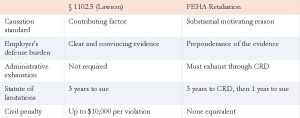
Why Plaintiffs Often Choose § 1102.5 Over FEHA
Practical Takeaways for Employers
Employers should continue to document in real time. The same-decision defense requires clear and convincing evidence. Performance issues, policy violations, and business reasons need to be recorded before a complaint is made, not reconstructed afterward. Employers should treat every reasonable complaint as a potential disclosure. After Kolla’s and Contreras, internal HR complaints are protected even if the employer already knew and even if the employee’s legal theory is wrong, making it increasingly important to train managers accordingly.
Employers should also be cognizant of timing. Adverse action taken against an employee shortly after a protected disclosure is the most common evidence of causation. If discipline was already in progress before a complaint, get the documentation in writing first. It will be difficult to rely on pre-complaint performance if there is minimal or weak documentation. It’s also critical for employers to remember there is no administrative exhaustion. Plaintiffs can file directly in court with a three-year window. There is no early procedural pressure on the plaintiff side.
Finally, employers should think carefully about settlement decisions in light of the Lampkin ruling. Before this decision, even employers with strong defenses often felt pressure to settle because a plaintiff’s attorney’s fees could reach six figures, and the employer might have to pay them even after winning. Lampkin changed that. Now, if an employer wins by proving it would have made the same employment decision regardless of the employee’s complaint, the plaintiff walks away with nothing, including no attorney’s fees. That removes a significant source of leverage plaintiffs previously had in settlement negotiations. If your documentation is solid and the same-decision defense is strong, fighting the case may now make more financial sense than it did before. This therefore changes the risk calculus meaningfully.